Extra: Antenna Simulation and Patterns
There is some free antenna simulation software
available on the Web called 4NEC2. The basis of the simulation
is the “Numerical Electromagnetic Code,” hence NEC. This
software can be used to simulate thousands of different
antennas. One such antenna is our sweet little waveguide
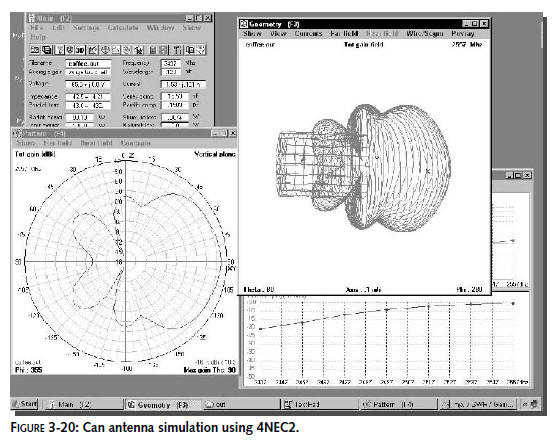
antenna. The screenshot in Figure 3-20 shows the
simulation for the can antenna we built in this chapter. You can
obtain a recent copy of NEC2 from the “links” section at
www.nec2.org
and download the coffee can antenna simulation model from
www.nec2.org/coffee.txt.
Antenna radiation patterns are created to show the
strength and direction for antennas. There
are two types of antenna radiation patterns: vertical
plane (or E-plane) and horizontal plane
(or H-plane). Antenna manufacturers use both of these
pattern diagrams to show how an
antenna works.
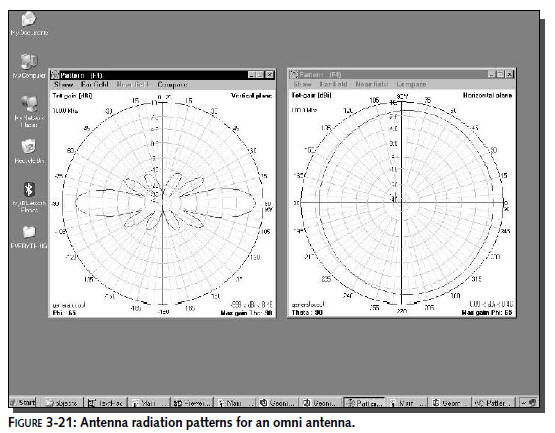
The antenna radiation patterns in Figure 3-21
are for a common dipole omnidirectional antenna. This type of
antenna simulation makes distinction between the vertical versus
horizontal. An omni antenna radiation pattern looks a lot like a
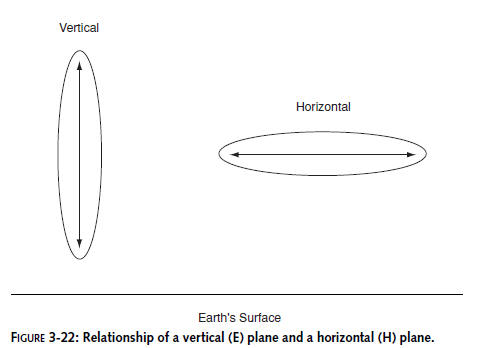
flattened donut. The diagram in Figure 3-22 shows the
relationship between the two pattern diagrams. Notice the
vertical plane is perpendicular to the Earth’s surface, while
the horizontal plane is parallel to the Earth’s surface. Each
plane is like a two-dimensional slice or circle with the center
of the slice at the center of the antenna.
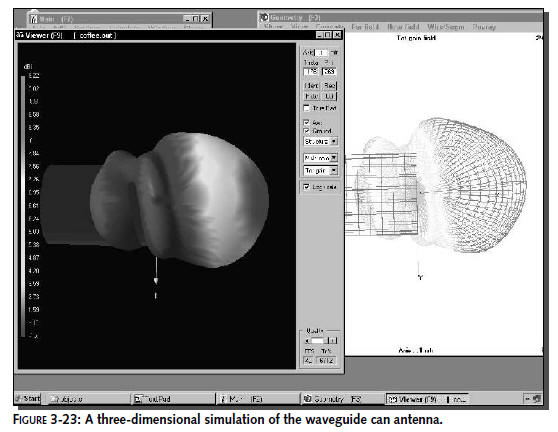
Moreover, 4NEC2 has a neat 3-D engine to show
you what the antenna would look like if you could see RF
radiation. See the screenshot in Figure 3-23 for a 3-D
simulation of the can antenna from this chapter.
This antenna works great in one general
direction. Also, it has about the same gain vertically as it
does horizontally.
Summary
In this chapter, you learned about waveguides
and the types of can antennas you can build on your own. The
waveguide antenna is very easy to build, but you need to know
where to drill. You also learned about antenna simulation and
what antenna radiation patterns are and how to read them. With
the knowledge from this chapter, you can go on to build and
experiment with many different types of antennas. And
understanding antenna radiation patterns puts you in the
driver’s seat when choosing what antenna would work best for any
situation.
Next up, let’s add a high-gain antenna to your
wireless access point. You’ll learn how to choose the antenna
type: omni versus directional. And you’ll find out how to stay
within the spirit of the law when it comes to RF power. Read on
to get the maximum range out of your wireless network.