Choosing a Wi-Fi Pigtail
A
pigtail acts
as a converter between large diameter cables and small
connecters commonly used on Wi-Fi
cards. Because of the very small
connector sizes, pigtails are difficult to build and require
highly skilled soldering techniques.We recommend that you
purchase pigtails for use in your projects. Several online
stores sell pre-built pigtails in specific lengths.
To purchase a pigtail, the vendor will need to know a few
things:
Length of pigtail:
should be less than 2 feet to keep signal loss low
Cable connector
: the type of connector to
plug into the larger cable (usually male)
Device connector:
the type of connector to plug into the Wi-Fi device (usually
female)
The device connector is specific to the type of Wi-Fi card or
access point being used.
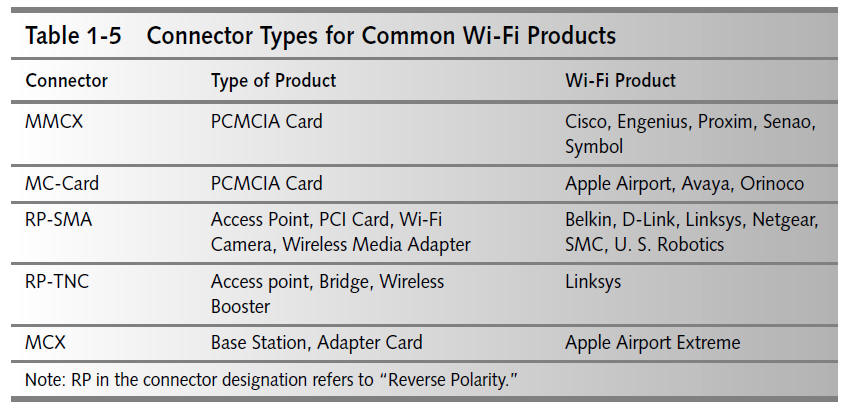
Connector Types for Wi-Fi Cards
There are almost as many connector types as
there are Wi-Fi device manufacturers.Table 1-5 lists some of the
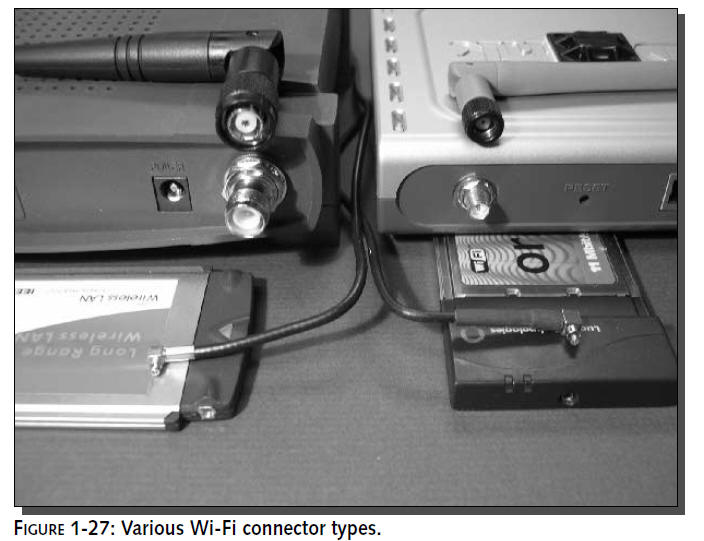
most popular connectors. The MMCX, MC-Card, RP-SMA, and RP-TNC
male connectors and some of the female devices
to which they attach are shown in Figure 1-27.
Finding Pigtails
Pigtails are not available in stores. They must
be purchased from vendors that construct them on a regular
basis. Sometimes you can find them locally at swap meets or user
group meetings. Usually it’s easier to buy them online. Here are
some popular sites:
www.ecwest.com
www.fab-corp.com
www.hyperlinktech.com
www.wlanparts.com
www.ydi.com
These stores generally sell antennas, wireless devices, and
cables as well as pigtails.
Cheap Cable Testing
When a transmission problem arises in a Wi-Fi
system, the first place to look is at the cables and connectors.
Connectors generally take the most physical stress in a system,
and also can be the first piece to break down while operating in
poor conditions. The middle of the cable or the inside of an
antenna is less likely to sustain damage if stressed when
compared to the cable ends and connectors.
This is where simple cable testing can be of
great value to troubleshoot a system.To check for continuity and
for shorts, use the ohm-meter function on a multimeter.Test the
entire length of the cable through each connector.
1.
Check for continuity from
center pin to center pin. This should be a short or zero ohms.
2.
Check from connector body
to connector body. This should be a short or zero ohms.
3.
Check from center pin to
connector body. This should be open or infinite ohms.
Often when you’re testing a cable, it’s already
installed on-site, which limits access to the cable ends. To get
around this, disconnect both ends of the cable and short the
center pin to the connector body on one end only. Then measure
resistance of the pin to the body on the other end.
The resistance should still be zero ohms (or
very close).
For the unlimited budget, products like a
time domain reflectometer (TDR), spectrum analyzer, RF Power
meter, and network analyzer can be used to test entire
transmission systems, including the cable. These usually cost
several thousand dollars to buy and hundreds to rent. If the
connector is presumed bad, replacing it is often much less
costly than extensive testing. And very often, the only way to
fix a bad connector is to replace it and start over.
Summary
Wi-Fi is radio at microwave
frequencies.Transmission lines at 2.4 GHz are more prone to
signal loss and must therefore be considered an important part
of the entire Wi-Fi system. A low-loss, large diameter cable and
a pigtail adapter makes it easy to position the antenna for the
best radiation pattern and signal strength.
Building connectors on-the-fly opens up a new
realm of independence. By obtaining the cable in bulk, and the
various types of connectors, it becomes a simple process to
build your own custom cables tailored to each application. And
the cable will be exactly as long as necessary. Read on to the
next chapter to explore antennas: how antennas are defined,
antenna radiation patterns, choosing an antenna, and pros and
cons of high-gain antennas. You’ll even see how to build a
simple omni antenna that will boost your range by up to 200
feet.