Finding Mass Quantities of Access Points
This game, AP-Hunt, is an access point game
inspired by the famous pasttime of war driving. AP-Hunt simply
requires basic wireless hardware and software and a means of
transportation. The objective is to accumulate the most number
of points. Generally, the more access points discovered, the
more points awarded.
Points are awarded based on a specific scoring
system weighted towards awarding unique and hard-to-discover
access points.To help prevent cheating, only access points with
associated GPS coordinates will score points.
To reduce the chance of cheating, the game
coordinator may seed the area before the game. This entails
setting up a number of access points with a unique SSID in the
playing area beforehand, and switching them to another SSID
during game play. If a team’s results include the “before” SSID,
they are submitting a log from before the contest timeframe.
Also, a team must discover one of the seeds during game play to
ensure the data is not from days or weeks prior to the contest.
The team with the highest number of points wins.
Scoring System
The essence of a contest is in determining a
winner.To make things interesting, an AP-Hunt game should have
some sort of scoring system beyond simply finding “the most.”
This scoring system here was inspired by the DefCon Wardriving
Contest of 2003. The DefCon contest is a type of access point
game with a set of rules created to distinguish hardcore
participants from the casual wardriver and encourage unusual war
driving techniques. A basic AP-Hunt scoring would look like
this:
One
point for each AP discovered
One
extra point for each AP with the default SSID
Two
extra points for each AP with WEP enabled
Three extra points for each unique AP (your team is the only
team that detected the AP). This score is optional and
implementing it will make sense only with a high number
of participants
Variations: Add points for local wireless landmarks such as
schools, stores, coffee shops, and
so on. Add points for furthest AP from the contest starting
line. Or possibly, add points for
off-road APs.
Obviously, scoring is up to the game
coordinator. Maybe in your first time out, just try to find the
most access points in a given time, like 1 hour. Then return to
base and have pizza while comparing results. The winner gets
bragging rights.
Hunting Equipment
There are some factors that can affect your game
play and ultimately your overall success while AP-Hunting:
hardware, antenna, software, and vehicle selection.
Hardware selection is a vital issue. It can mean
the difference between detecting an access point or not, and
thus winning or losing. There are two basic types of
supplemental hardware involved with hunting: a wireless adapter
and an external antenna.To be amongst the top ranks
of competitors, a wireless adapter has two
essential elements: power output (and, therefore, receiver
sensitivity) and the ability to accept an external antenna. A
standard wireless adapter has a power output of about 30 mW,
while an enterprise adapter will usually have 100 mW. And
carrier-grade adapters boast an output of 200 mW. In general,
the higher powered adapter will also have a more sensitive
receiver, which directly relates to how well the adapter can
“pull in” a weak signal and log the access point.
Once you’ve selected a suitable wireless
adapter, the next step is to choose an external antenna. If at
all possible it is best to have both an omnidirectional and a
highly-directional antenna for all foreseeable scenarios. You
should have at least an external, vehicle-mounted
omnidirectional antenna.
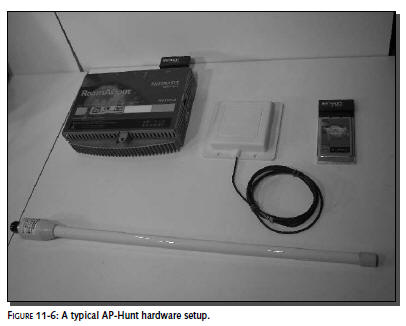
Figure 11-6 shows an example of an AP-Hunt setup
including wireless adapter, omnidirectional, and highly
directional patch panel antenna.
While playing AP-Hunt, users of Kismet Wireless
will have a considerable advantage because Kismet can detect
access points that are not broadcasting their SSID or beacon
signals.
Oftentimes, sheer numbers may be the pivotal
factor between winning and losing.
Transportation plays a
great role in AP-Hunt.Traditionally, automobiles are used in
conjunction with GPS mapping software to sweep the area as it
approaches, detecting access points along the way. Although this
is still the most widely accepted method of transportation,
several
nonconventional methods have proven to provide
much broader coverage than an automobile could hope to achieve.
Recently, helicopters and private airplanes have been used to
scan large swaths of the landscape to pick up dozens more access
points outside the range of ground-based vehicles.
Using airborne vehicles while scanning for
access points is known as “warflying.” Perform a Web search for
warflying, and among the usual combat aircraft Web sites will
appear many sites on war driving with aircraft.
AP-Hunt in action: The DefCon Wardriving Contest
For the past eleven years at the beginning of
August, thousands of the world’s most fervent hackers, security
professionals, and even government officials have converged on
the city of Las Vegas to participate in what has become one of
the largest underground security and technology conferences in
existence, fondly named “DefCon.”
Although DefCon began simply as an underground
hacking conference, it has evolved into something much greater.
In the past few years emerging wireless technologies have made
their way into the conference, spawning entirely new facets such
as the DefCon Wardriving Contest. The DefCon Wardriving Contest
has grown to become a cutthroat battle royale of wireless
network detection, pushing war driving and access point gaming
in an ever-improving direction.
In recent years, participants armed with
laptops, wireless adapters, and external antennas have used
everything from standing still on top of a building, to vans,
cars, and motorcycles in order to claim the title of DefCon
Wardriving Contest champions. DefCon Wardriving contest
participants have even gone to the extent of renting a private
helicopter, allowing them to detect access points typically
unreachable through traditional AP-Hunting methods.Who knows
what strategies and tactics will be used at the next contest?
An Access Point Treasure Hunt
Treasure Hunt is an access point game in which
teams search for access points based on clues discovered in the
SSID. As the game unfolds, each access point discovered leads
the team to the next access point, and so on until the trail
ends. There are two main categories of play in the Treasure Hunt
access point game.
Best Time—The winner of the “Best Time” category will be the
team that is able to complete the
course in its entirety in the least amount of time possible.
Best Signal—The winner of the “Best Signal” category will be the
team that is able to record the highest Signal-to-Noise Ratio
for each of the given access points.
Playing Treasure Hunt
Treasure Hunt is one of the most rewarding
access point games but it also requires much setup and
planning.When organizing a treasure hunt, several access points
are required to be spread out over a relatively large area. It
is best to organize the field of play based on several maps
sliced into grids. Often a local paper-based
street map will have a grid coordinate and a wellknown page
numbering system.
If the game participants do not have a local map
publication, create a simple map layout using mapping software
to generate the map, and an image editing program to divide the
map into squares covering about one-half mile each. Print these
out for each participant.
Each access point should be
spread apart by a significant distance and each access point
SSID will contain the clue necessary to determine the location
of the next access point. Each access point should contain a
similarly formatted SSID in order to provide clues.
A sample SSID might be:
TH0504-P5-J-4-03
The first section, “TH0504” is a unique game
name (TH) and date (May 2004). The second section, “P5” means
page 5 in a pre-determined map handout, booklet, or publication.
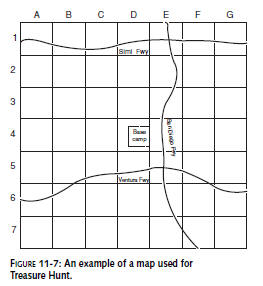
“J-4” represents the grid coordinates on that map (see Figure
11-7). And the final section “03” means this is clue number
three (numbering is optional, but it’s nice to have).
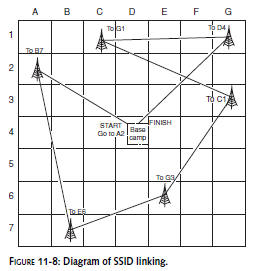
This SSID points to where the next access point
can be found on the map. Each access point is a link pointing to
the next site to discover and proceed from there. Figure 11-8
shows a diagram of how this contest works. Plan the path of
travel to help avoid participants finding clues out of order
To begin with, each team is given the rough grid
coordinates and a specific map in order to determine the
location of the first access point and using the clues located
in the SSID’s of the access points, each team must then locate
each additional access point until the course is completed.
Variations for treasure hunting
A treasure hunt can be so many things. The SSID
pointer is probably the most basic: pointing you to the next
link in the chain. But with some imagination, you can develop a
truly unique game.
Some ideas to consider are: Have the SSID
provide a clue, instead of a directional pointer. For example,
“boardwalk canals and musclemen” could mean Venice Beach. Or,
make the SSID a phone number (that is, “TH0504-555-1212”) with
an answering machine message, “Get to the payphone by the
stadium and find the access point to the East.”
Another fun, though even more painstaking
alternative, is to make each access point forward the user to a
Web site holding the next clue. A team member would need to
associate with the access point, obtain a dynamically assigned
TCP/IP address, and surf to a Web site unique to that access
point. Once at the Web site, any type of clue or challenge could
be presented.
Imagine a treasure hunt where participants had
to solve a riddle, puzzle, or pass a quiz before being given the
next clue. With these few variations, the Treasure Hunt AP game
can be a potentially challenging event for participants and game
coordinators!