Playing Access Point Games
Traditionally, an
access point,
or AP, is thought of as a type of networking
hardware that is used solely to provide wireless access
to a network. Although this may be
so for the average wireless user, a subset of dedicated wireless
fanatics have found several ways to transform your typical
access point into a source of entertainment and hours of
delight.
This chapter outlines several types of exciting
access point games and details on how to play them. These games
come in many forms, such as a “fox and hounds” game, capture the
flag, or a treasure hunt. However, they are all based on the
nature of an access point to “give itself away”—that is,
broadcast the configured SSID to all willing listeners.
In order to truly enjoy playing access point
games, you must first remember a few key details about access
points and their functionality. An access point is a radio
transmitter and receiver.When a laptop client requests basic
information from an access point, such as SSID, manufacturer,
channel number,WEP status, and other networking information, the
access point will respond with that information. This
broadcast/request pattern is the key to playing AP games.
Playing access point games implies that the
access point should be “discoverable.” That is, SSID
broadcasting is enabled. When discoverable, regular wireless
clients and war driving tools would be able to discover the
access point. Of course, hard-core AP gamers could bump up the
difficulty by turning off SSID broadcast
so only passive war driving tools (such as
Kismet Wireless) would discover the access point. The choice is
yours!
To play most
of the games covered in the chapter, you will need only standard
wireless equipment properly configured, similar to that required
for war driving.
Items you will need include:
➤
Laptop
computer
➤
Wireless
adapter
➤
GPS
receiver
➤
Kismet,
NetStumbler, or other war driving software
➤
External
antenna (optional)
Although this is simply a “bare-bones” list of
what you need to get started with the games outlined
in this chapter, there are several optional
items which could significantly increase the
impact of your game.
Some optional equipment includes:
Mobile battery power
DC-to-AC inverter
A
varied selection of external antennas
Mapping software or other in-car navigation
Access point enclosure
Paper map for offline reference
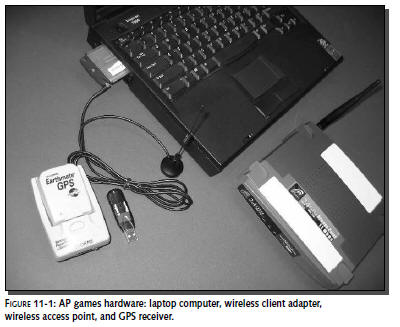
Some of the basic items are shown in Figure 11-1.
➤
Wireless
access point
An external antenna can be
attached to many different wireless adapters and will
significantly increase range. Omnidirectional antennas are
preferred for 360-degree sweeping coverage, while a
unidirectional antenna, such as the famous cantenna you built in
Chapter 3, can be used for focused, directional coverage.
The Basics of AP Gaming
The idea of access point gaming is that you are
out to find and log wireless access points. These access points
can be placed beforehand as with a treasure hunt, placed to seed
a playing field as with a traditional AP hunt, or set up in
specific locales to create a real-world social networking
environment.
The game coordinator will design the rules,
layout, and boundaries of the game being played. Briefly, the
games described in this chapter are:
Foxhunt—Find the hidden access
point
AP-Hunt—Discover the most access
points in a set amount of time
Treasure Hunt—Step through a
planned route where each new discovery gives you a clue to the
next destination
Capture the Flag—Find
all the “enemy” access points and return to base with your
booty, a log file showing their
locations
irtual
Real-Space Tours—Bridge
the digital and the real with location-aware content fed to
visitors within a matrix of access points. (Not quite a game,
but very entertaining!)
In order to be successful while
playing the games covered in this chapter, you will be
constantly refining your skills in pinpointing the location of
access points. Pinpointing access points can be achieved by
using two standard methods:
Drive-by detection
Triangulation
Both methods are valuable in
different circumstances, and you may even employ both methods
during the same game.
Detecting an Access Point
on a Drive-By
This is the traditional war driving
scenario. As you travel past an access point, the war driving
software detects the access point and logs its position.
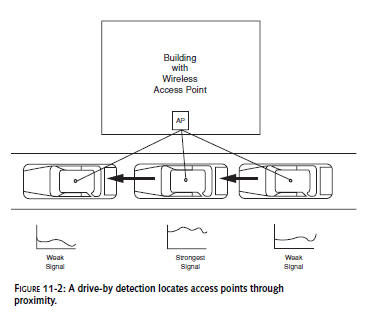
As you drive around, the signal level will
grow stronger or weaker—usually indicating that you are
closer or further from the access point.
Figure 11-2 shows a diagram of
this process. The access point is in a building and different
signal levels help to betray its approximate location. As your
detection computer comes within close proximity of the access
point, the signal strength gets higher.
Always play AP games with at least one passenger
(the more the merrier). The task of driving safely while
managing the computer in an AP game may well be impossible. As
the driver, it’s your job to assign the task of detection and
navigation to the passenger(s) and stay safe.
Finding an Access Point by Triangulation
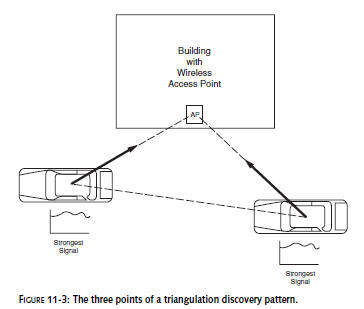
Triangulation may well be the oldest radio-wave
positioning method known.Triangulation is a method of taking a
directional sample of a radio source, moving some distance and
taking another directional sample. If all went well, the two
directions you sampled should end up pointing to a single third
location, making a triangle.
Figure 11-3 shows a triangulation pattern using
a directional antenna. Directional antennas are the easiest way
to detect an access point by triangulation. The cantenna, a
panel antenna, or a Yagi antenna is usually sufficiently
directional to aid in pinning down an access point.
When you’re discovering access points by
triangulation, you can get a misreading due to the nature of
wireless reflections and the concept of multipath signals. It’s
possible to receive a stronger signal bouncing off of, say, a
building than when you point directly at the access point.
Keep this in mind and perhaps add more points to your
“triangle.”
Crazy Like a Foxhunt
Foxhunt is a challenging and exciting access
point game that requires the setup of a remote access point (The
Fox) in a location unknown to the participants of the game.
After general boundaries are set, the participants set out with
the objective of pinpointing the exact location of the hidden
access point. The first participant or group to pinpoint the
access point wins. This AP game is quite simple, and probably
the easiest to coordinate and start playing.
1.
Get a fox
2.
Send the fox out running
3.
Wait some amount of time
4.
Chase the fox
The Fox
The heart of this game is based around an access
point, The Fox, and the components that enable its operation.
Although the placement and setup of The Fox is ultimately your
choice, a modular setup is preferable. Being able to place it in
a variety of locations will enhance gaming immensely.
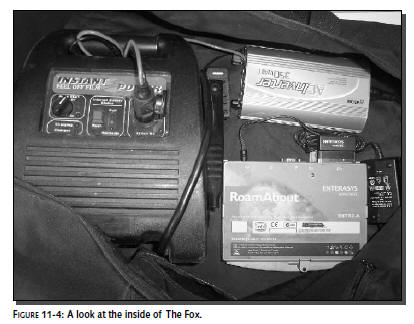
Figure 11-4 shows a simple “Fox” setup. Notice
careful attention paid to the organization of the access point,
battery pack, and power inverter, as well as the cleanly run
wiring. This attention to detail helps prevent unforeseen
outages during the game.
This game does not necessarily employ a special
SSID. But a unique, pre-determined SSID will help the hunters
easily identify the target.
An SSID of “Fox” is too simple and you may
easily come across it in the wild. Try an SSID of “LAFoxHunt-
Aug2004” or some sort of named and date-stamped SSID. You may
find it amusing to later discover The Fox listed on an online
war driving database!
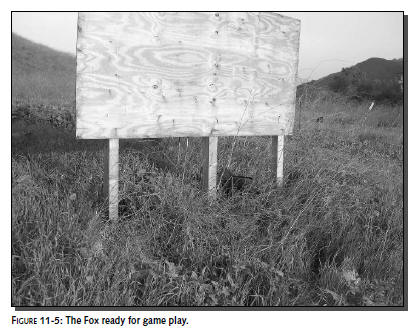
A standard modular access point setup includes
(see Figure 11-5):
Access Point—A standard 802.11b access point is the heart of The
Fox.
12-volt Battery Pack—A 12-volt battery pack supplies the power
to the unit. The battery
is the key to the modularity of The Fox.
Power Inverter—A power inverter is used to convert the voltage
of the battery to that of the access point.
Canvas Duffle Bag—A canvas duffle bag will serve as the platform
to house all of the equipment
required in one simple package and allow The Fox to be moved
from one location to another
quickly and easily.
A tip about batteries: A 7.0 ampere-hour (Ah)
battery will run for one hour at 7 A, or 7 hours at 1 A. In
tests, a broadcasting access point connected to an inverter
while running on battery power was pulling 900 mA or 0.9 A, and
ran for over 9 hours on a single 7.0-Ah battery. This came out
to about 8.1 Ah, somewhat better than the 7.0 Ah rating.
Variations of a Foxhunt
Although the general game play and rules are the
same throughout, there are a few variations of an AP games
Foxhunt:
Standard Foxhunt
Mobile Foxhunt
Room Service
Foxhunt
The standard variation of the game is usually
played with two to six players. Standard Foxhunt requires that
the participants of the game track The Fox solely on foot. A
smaller set of boundaries is usually required, typically a few
hundred yards square, as it would be no fun to have to search an
overly large area on foot. A mid-sized park is optimal, as The
Fox may be hidden in many places, such as small brush.
The Mobile Foxhunt is a variation of Foxhunt in
which two to six teams comprised of two to four participants
each track The Fox using automobiles. A larger set of boundaries
is required for Mobile Foxhunt, as the use of automobiles
permits a much greater relative scale. A good set of boundaries
is 20 to 40 blocks square. The Fox is typically placed in a host
automobile and parked in a remote location.
Room Service Foxhunt is a great variation of
Foxhunt intended for fun on vacation, but can be played anytime
and can host a number of participants ranging from 2 to 40. Room
Service Foxhunt is best played in a hotel setting. It is a good
general rule of thumb when playing this variation of Foxhunt to
have a maximum of two to four times the number of participants
as there are floors in the hotel. The boundaries can range from
inside the hotel itself to the entire area of the hotel
depending on the size of the group, courtesy to other hotel
guests, and tolerance of hotel management. The Fox is typically
hidden in a room or a common area.
A GPS and mapping software may prove to be
invaluable in quickly pinpointing The Fox while playing
variations of Foxhunt with a larger set of boundaries such as
Mobile Foxhunt.
Foxhunt Tips
Set up rules ahead of time. Determine the
boundaries and timeframe for success. As the game coordinator,
stay in contact with The Fox either by cell phone or radio.
Also, ensure you have all of the participants’ contact
information in case the game has a problem and must be aborted.
As a player, there’s nothing more annoying than looking for an
access point that isn’t there.
Determine the winner. Perhaps the winner is the
person or team that finds The Fox in the least amount of time.
Or perhaps the first team to return with a digital picture of
The Fox is the winner. Are GPS coordinates enough or does the
team need an address? Or perhaps a visual description is more
suitable (for example, “Building 4 in the bushes near the South
Entrance”)?
There is probably an unlimited number of
variations on this AP game. The foxhunt is an old tradition
which has carried over into HAM radio, CB radio, and now
wireless access points. Uphold the tradition and host a foxhunt
this weekend!