

Qualitative Project Risk Analysis - 2
What do you mean by probability and severity scales, and how do I use them?
Assessing Probability
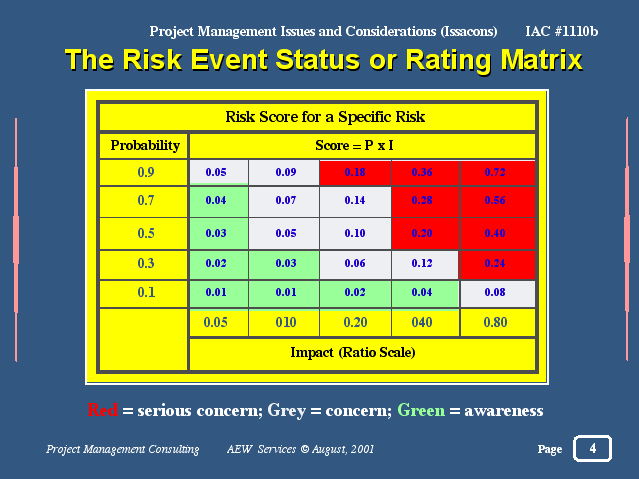
Probability is best assessed on a five point scale as follows:
1. Highly unlikely: p = 0.1
2. Unlikely: p = 0.3
3. Possible: p = 0.5
4. Moderately probable: p = 0.7
5. Highly probable: p = 0.9
Assessing Severity
Severity is also best assessed on a five point scale as follows:
1. Insignificant: s = 0.05
2. Moderate: s = 0.10
3. Medium: s = 0.20
4. Severe: s = 0.40
5. Catastrophic: s = 0.80
· Note the ratio scale
The Risk Event Status or Rating Matrix
Red = serious concern; Grey = concern; Green = awareness
Assessing Probability
·
Strive for range, not accuracy!
·
Ask Questions like:
· Are our chances above or below 50%?
· If above (below) better than 90% (worse than10%)?
· If below 90% (above 10%) then above or below 70% (30%)?
·
Donít ask "What is the longest time this
activity could take?"
· The inevitable answer will be "Forever"!
·
Deal with the Impact scale the same way
· Except note that it is a ratio scale, not linear
Other techniques - 1
Testing the project's assumptions
· Your project does have a list of assumptions, I hope?!
· Test them against two criteria:
· Stability: How true will the assumption remain through the project life span?
· Consequences: What if the assumption proves to be false?
· Alternative assumptions should also be identified
Other techniques - 2
Data precision review
· Qualitative risk analysis requires reliable and unbiased data
· If the result is to be meaningful
· Evaluate the data against the following criteria
· Extent of understanding of the risk event
· Availability of data, how much do we really know?
· The quality of the data we have
· Its reliability and integrity
Beware of the Fatal Flaw!
·
Always watch out for the risk event with
the "fatal flaw"
· It may look very unlikely
· But it could be devastating!
·
A "fatal flaw" project risk event is one
that presents a situation that simply cannot be recovered
· The technology proves to be inappropriate
· A key knowledge worker moves on
· Political climate changes dramatically
and so on. . .
What have we accomplished?
You should end up with:
· An overall risk ranking for the project
· Perhaps as a basis for proceeding further
· A prioritized list of project risks
· For closer scrutiny, perhaps for association with scope, quality, time, cost or functionality, etc
· Priority risks for further analysis
· I.e. Quantitative Risk Analysis