

Communication Models
What are communication models, and why should I know about them?
Why communication models?
·
About models
· Models are generally simple diagrams
· They help us to understand "What's going on!"
·
In the diagrams that follow
· Note how the communication requires a "medium"
· A telephone line, Email, paper, or just plain air!
· Note also how some process is involved
· And relationships are established between the parties
Simple model examples
On the following page
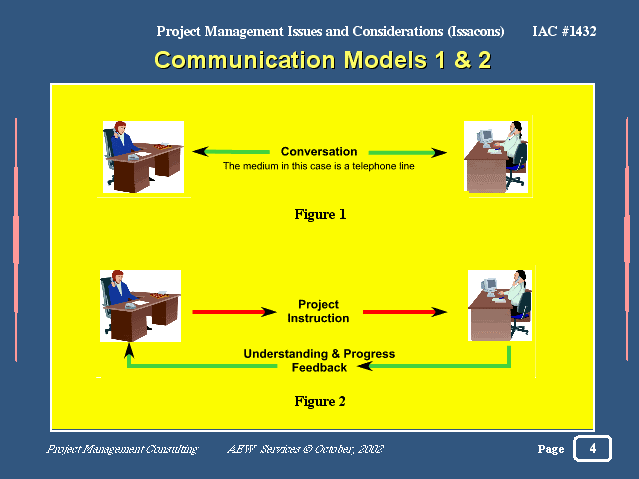
· We show two simple communication model diagrams
· Figure 1 shows a typical two-way telephone conversation
· Two parties appear to be equal for this communication
· Figure 2 shows how such an exchange becomes an important transfer of project information, a "communication"
· One is a superior, the other a subordinate
· Note also the importance of feedback
· To ensure the message is correctly understood
Communication Models 1 & 2
Figure 1
Figure 2
More complex models
On the following page
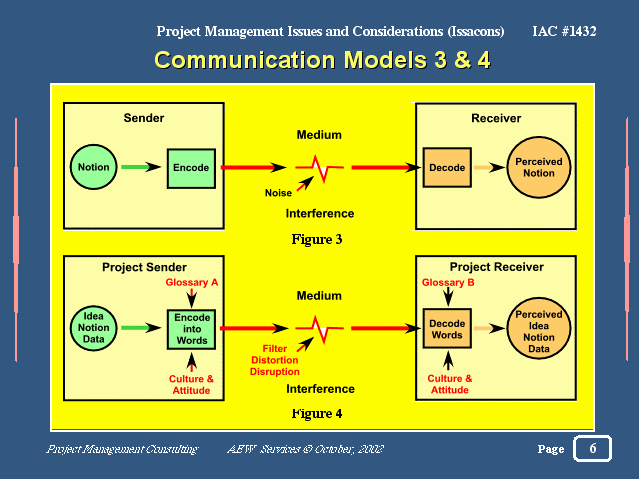
· We show two models that are more elaborate
· Figure 3 shows how the sender must encode into words
· And the receiver decode
· Note also the presence of "noise" in the transmission
· Figure 4 shows a typical project transmission
· Project teams are made up of diverse people
· Often working together for the first time
·
Each with their own culture, attitude,
and project management glossary!
Communication Models 3 & 4
A more formal explanation - 1
·
Elements of information exchange
· Sender (source), vehicle (channel) and receiver
·
The source
· Every communication originates somewhere
· Supervisors, subordinates, peers, associates
·
Encoding
· The originator's ideas are translated into a systematic set of symbols
· This provides the structure in which ideas, purposes, intentions or directions
· Are expressed as a coherent message
A more formal explanation - 2
·
The message
· The actual result of the encoding process
· The form that the message takes depends on the channel used
· Examples: speech, document, memo, Email, voice mail, phone call, etc
·
The channel
· The medium through which the message is carried
· From sender to receiver
· Note: Different media may be more or less reliable
A more formal explanation - 3
The Receiver
· The recipient of the message must first decode the incoming information
· Depending on the channel and complexity of the message, translation depends to a great extent
· On the receiver's knowledge, experience, culture and attitude
· In addition, the incoming data may well have been modified by conditions in the medium
· Such as disruption or distortion
· Cell phones are a good example!
· And it may be "filtered" by what the recipient wanted to hear!
Responsibility
·
The difficulties of communication are
characterized by the following humor
"I know that you believe you understand what you think I said, but I am not sure you realize that what you heard is not what I meant!"
·
So, who is responsible for the accuracy
of the received message?
· The receiver may be responsible for ensuring the authenticity of the sender
· But it is the sender who is in control of the message content
· And therefore responsible for it arriving
· And being correctly understood!
General communication tips
Good communication requires sender to
· Be clear and concise
· Consider your audience
· Especially in status reporting
· Avoid any unnecessary jargon
· Follow up with written confirmation
· Request feedback to ensure message is understood
Phone tip
If your caller is away from the phone
· Leave a message to identify yourself
· Give the time and date of your call
· State clearly what you want the recipient to do
· And leave your phone number!
Email tip
To speed those emails
· In the subject box, insert one of the following
· REQUEST
· RECOMMENDATION
· REPORT
· INFORMATION
·
EVALUATION
Note: All in capitals !
· And for the content in the body of the Email
· Follow the Wideman 3-4-5 Principle
· See Issacon #1453
Conclusion
If you are aware of these things
· You can be more alert to "communication failure"
· Before they become a serious problem
· On your project!