

Making Light Dance to the Music
Trying It Out
Okay, you’ve been taking it on faith that this is going to be a cool project, and we appreciate it. But now it’s time to get the thing going and see whether you think it’s as much fun as we do.
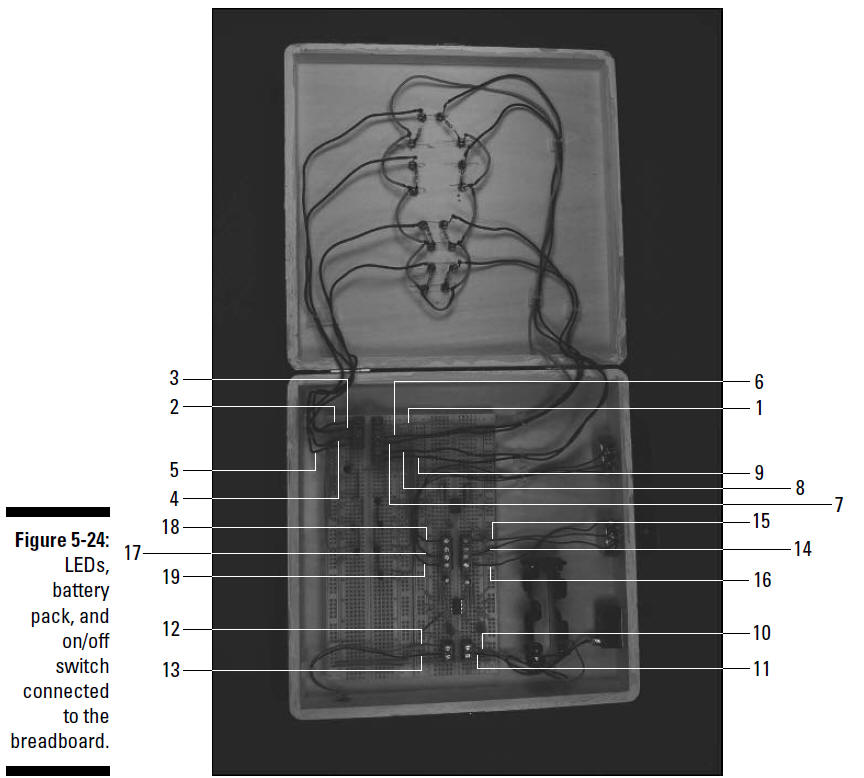
You can use any music you like to get the effect going, but we found that music with lots of instruments — like a swing band with lots of brass — works best. Also, music with an upbeat tempo moves along and gets the lights switching on and off faster, which makes the effect better. Our favorite number for dance to the music? Ella Fitzgerald singing
Take the A Train, by Billy Strayhorn. (Ask your parents; they might have heard of it.)Here are the simple steps to get this project going:
1. Pop the batteries into the battery pack.
2. Flip the on/off switch to on.
3. Put on some music.
That’s it! Watch the lights go on an off in response to the high and low frequencies in the music. You can adjust the sensitivity of the LEDs by turning the potentiometers. Here are the obvious things to check out if you’re having a problem: Check that all the batteries are fresh and tight in the battery pack and that all face the right direction. If one or two LEDs aren’t working, replace them. If two LEDs in series with each other aren’t functioning, you might have reversed the long and short leads of the LEDs; if so, just replace that pair of LEDs.
You are playing Brahm’s Lullaby. Brahm’s Lullaby will not light up a single LED. Switch to Snoop Doggy Dogg or Motörhead.Taking It Further
By now, you’re probably jumping and jiving to this cool light show, playing every CD you have to see what they do, and still, you want more? Here are a few different ways to take this project further: Obviously, you can change from a musical staff and notes to any kind of shape you might want to define with your LEDs. You can have two stars or a sun and moon, for example. You can use a
band pass filter to add more layers of frequency. For example, between your high pass filter and low pass filter, you could add two more band pass filters to hit intermediate frequencies and have four sets of LEDs going off in response to music. You could miniaturize your circuit so you can pin it on your shirt or take it with you to parties. A few steps would help you to get a smaller circuit. First, you could use smaller LEDs. (This project uses T-1 3⁄4 LEDs, but you could use T1 LEDs.) You could also use a different method of building the circuit called a dead bug circuit. Imagine an IC turned on its back with its little prongs sticking up on the air, and you get an idea of what we mean. This method doesn’t involve a breadboard but makes connection directly to the LED. Check out www.arrl.org (American Radio Relay League online) for some ideas about using the dead bug approach to building circuits.