
Making Light Dance to the Music
Perusing the Parts List
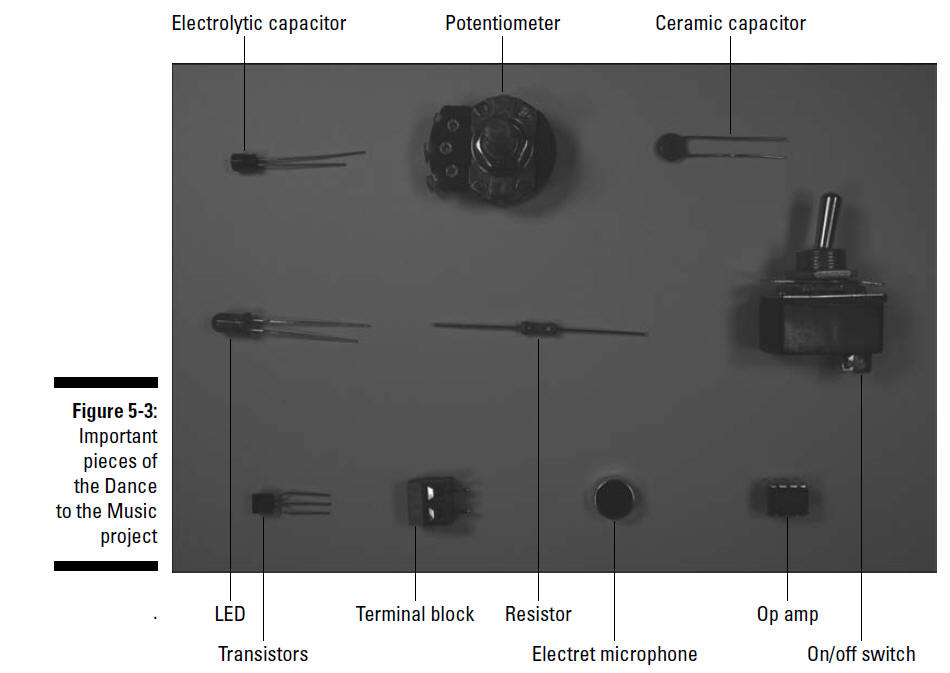
It’s off to your nearest electronics store or online vendor for those electronic parts you use to build the circuit and assemble the box that contains all those LEDs. The circuit that transforms music into your dancing light show involves the following parts, several of which are shown in Figure 5-3:
2.2 kohm resistor (R1) Eight 220 ohm resistors (R11–R14, R28–R31) Eight 100 ohm resistors (R15–R18, R32–R35) Two 10 kohm potentiometers (R7, R24) Four 47 kohm resistors (R3, R4, R20, R21) Two 100 kohm resistors (R5, R22) Two 2 kohm resistors (R2, R19) Two 5 kohm resistors (R6, R23) Two 1 kohm resistors (R9, R26) Two 220 kohm resistors (R10, R27) 0.001 microfarad ceramic capacitor (C3) Two 0.1 microfarad ceramic capacitors (C1, C4) Two 10 microfarad electrolytic capacitors (C2, C5) Eight green size T-1 3⁄4 LEDs (LED1–LED8) Eight red or orange size T-1 3⁄4 LEDs (LED9–LED16) Two LM358 op amps (IC1 and IC2) Electret microphoneWe use the Horn part #EM9745-38 electret microphone for two reasons: high sensitivity and a reasonable size that makes it easy to handle. You can use other electret microphones; see Chapter 3 for the criteria to help you choose one.
Two 830-contact breadboards One 4 AA battery pack with snap connector Eleven 2-pin terminal blocks Two knobs (for the potentiometer) Eight 2N3904 transistors (Q1–Q8) A wooden boxWe found one at a local craft supply store that was just the right size to
hold the electronics for this project.
An assortment of different lengths of prestripped, short 22 AWG wire Several feet of black 20 AWG wire Several feet of red 20 AWG wire